AI Lead Management

AI Lead Management for UK Businesses

Make sure good enquiries have somewhere to go next.

Getting a lead is only the beginning. Someone still has to notice it. Understand it. Work out whether it is relevant. Find the right information. Decide who should handle it. Respond. Record what happened. And make sure the next action actually happens.

We help UK businesses use AI and automation to improve the work between a lead arriving and a person taking the right next step.

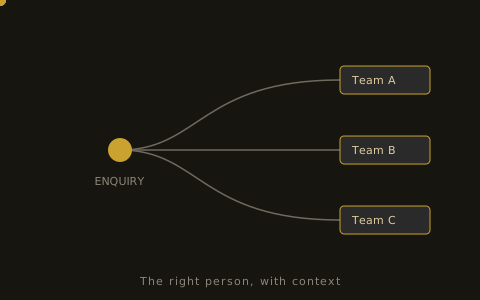
One enquiry routed to the right owner
Where leads go quiet

Leads rarely disappear all at once.

They get lost in the gaps.

None of these is a dramatic failure. That is exactly why they are easy to overlook.

AI lead management is not about creating an autonomous salesperson. It is about helping the process notice, understand and move work forward.

The first few minutes

What happens when a new lead arrives?

That first few minutes can involve more work than it looks.

Imagine somebody completes a form on your website. The form itself is easy to automate. But what happens next?

These are not all simple trigger based decisions. That is where AI can start to participate in the workflow.

AI enquiry handling

Understand first. Then decide what happens.

An AI workflow can read incoming enquiries and help structure what happens next. Depending on the process, it could:

The agent does not need permission to do all of those things. Each action can have its own level of authority.

AI lead qualification

Your criteria. Not the AI's opinion.

Lead qualification is a good example of where AI can sound more capable than it should. We do not want an AI deciding, by itself, what a "good customer" looks like. Your business defines that.

You might care about:

The service someone needsCompany typeLocationProject requirementsBudget information, where relevant and providedTimingExisting relationshipInformation that must be present before the enquiry can progressOther commercial criteria specific to your business

AI can help interpret the information available and compare it against those agreed criteria. It can identify what is known. What is missing. What fits. What needs clarification. And what needs a person to decide.

The qualification logic belongs to your business.

Beyond the number

Qualification is not always a score.

Sometimes the useful answer is simply "we need to know more".

Not every lead needs a mysterious number attached to it.

82
Lead score: 82
It looks precise. But what does 82 actually mean?

For many businesses, useful qualification is much more practical.

AI can help organise those decisions without pretending uncertainty does not exist.

Want the thinking behind this?

The Agentic Selling knowledge hub covers how AI can support qualification, routing and follow-up, and the principles behind using it responsibly.

Explore Agentic Selling →
Route the lead with context

Do not just send another notification.

Routing a lead to somebody is easy. Giving them what they need to act on it is more useful.

Instead of: "New lead received." a workflow could prepare:

The original source material remains available. The AI provides the preparation. The salesperson gets the context.

Respond with judgement

Respond without pretending every enquiry is the same.

Speed matters less if the response is useless.

Automatically sending: "Thanks for your enquiry. Someone will be in touch." is easy. Sometimes that is all you need. Sometimes a more useful first response depends on understanding what the person actually asked.

AI can help prepare a response using the enquiry and approved information from your business. That response could then:

The goal is not automatic communication for its own sake. It is an appropriate next step.

Keep the CRM useful

The lead should not have to be entered three times.

Information often enters a business through one system and then has to be recreated somewhere else. Website form. Inbox. CRM. Spreadsheet. Task system. Sales notes.

AI and automation can help move and structure information so people do not repeatedly copy the same details. That might include:

But automatic updates should still have boundaries. The system should know what it is permitted to change and what requires review.

Follow-up with context

"Remember to follow up" is not much of a system.

Follow-up often fails because the task itself contains too little information. Follow up with James. Fine. About what? What happened last time? Who was waiting for whom? What did we promise? Has anything happened since? What should we say?

An AI workflow can gather that context before somebody needs it. It can then recommend the next step or prepare the communication. For agreed situations, it might eventually be allowed to carry out specific follow-up independently.

But the purpose is not to chase every silent lead forever. Good follow-up needs context and boundaries.

Know when not to follow up

Know when not to follow up.

Automation should be able to stop too.

A useful lead management workflow should not only know when to act. It needs rules for when not to.

Those are not annoyances to engineer around. They are part of the process. When the workflow reaches its limits, it should stop and escalate.

Surface the leads that need attention

Your team should not have to remember to look everywhere.

There may be information sitting across:

Your CRMShared inboxesWebsite enquiriesCalendarsTasksMeeting notesSales systems

The problem is not necessarily storing it. The problem is knowing what deserves attention. A workflow can help surface situations such as:

This is one of the most useful roles an AI agent can have. Watch the process and bring the exceptions to a person.

You decide what happens automatically

You decide what happens automatically.

Lead management does not need to become autonomous overnight. An AI lead workflow can start cautiously.

01ReadUnderstand the enquiry and relevant permitted information.
02RecommendSuggest how the lead should be handled.
03PreparePrepare the CRM update, routing decision or response.
04Act with approvalCarry out the action after somebody approves it.
05Act within limitsHandle specific, well understood situations independently.
06EscalatePass anything outside those boundaries to a person.

Different actions can sit at different levels. An agent might automatically classify an enquiry but require approval before contacting the prospect. Autonomy should earn its place.

A practical lead workflow

From website enquiry to next action.

01

A lead arrives

The website form triggers the workflow.

02

AI understands the enquiry

It extracts relevant information and identifies what the person appears to need.

03

Existing systems are checked

The workflow looks for permitted context such as an existing company or contact record.

04

Qualification rules are applied

The available information is compared against criteria defined by your business.

05

Missing information is identified

The workflow determines whether anything important needs clarification.

06

The next action is prepared

This might be routing the lead, preparing a response or requesting human review.

07

The CRM is updated

Agreed information is recorded without unnecessary copying.

08

Follow-up is tracked

If another action is needed later, it remains part of the workflow.

09

Exceptions are escalated

Anything outside the agreed rules reaches a person.

One enquiry. One connected process. Far less relying on somebody remembering every step.

What should remain with your team?

Qualification does not remove commercial judgement.

AI can help organise information. It can apply agreed criteria. It can identify patterns. It can prepare actions. But there are still situations where a person should decide.

A strategically important opportunityAn unusual commercial requestA complex prospectNegotiationAn exception to normal qualification criteriaA relationship that requires context the system does not haveA decision with significant consequences

The purpose of AI lead management is not to prevent humans getting involved. It is to help your team get involved where their judgement is most useful.

Start with one lead source

Start with one lead source.

You do not need to connect everything on day one.

If leads currently arrive through your website, start there. Or your sales inbox. Or referrals. Or a particular campaign.

Follow that lead through the business. Where does it go? Who touches it? What information gets added? Where does somebody have to make a decision? Where does it wait? Where can it disappear? What happens next?

That gives us a workflow worth examining.

Map your lead process

Frequently asked questions

The questions UK businesses ask us first.

What is AI lead management?
AI lead management uses AI within parts of the process for handling sales leads, such as understanding enquiries, gathering context, qualification, routing, preparing responses, maintaining CRM information and supporting follow-up.
Can AI qualify leads automatically?
AI can assess information against criteria your business defines. Whether it is allowed to make a final qualification decision automatically depends on the workflow, the reliability of the criteria and the authority you choose to give it.
Can AI respond to website enquiries?
Yes. AI can prepare responses using the enquiry and approved business information. Those responses can be reviewed by a person or, for tightly defined situations, sent automatically if you choose.
Can AI route leads to different salespeople?
Potentially, yes. A workflow can use agreed rules and information from the enquiry to help determine where a lead should go. Unusual or uncertain cases can be escalated for human review.
Can AI follow up with leads automatically?
It can, within defined rules. We prefer to design follow-up around context rather than simply sending repeated automated messages on a timer.
Can AI update our CRM?
Potentially, depending on the CRM and the access available. Updates can also be prepared for human approval rather than made automatically.
Does this replace lead scoring?
Not necessarily. Some businesses use scoring effectively. Others need more practical qualification rules. We design around how your business actually decides whether and how to pursue an opportunity.
What happens if AI cannot confidently understand an enquiry?
It should not be forced to guess. The workflow can flag the uncertainty and pass the enquiry to a person.
A lead should always have a sensible next step.

A lead should always have a sensible next step.

Not necessarily an automated one. Not necessarily an AI generated one. Just a clear one. We help you build the process that gets it there.